Wine harvest in Burgundy: how to take part in the 2026 vendanges
Simon Stoll
Oenosuite Founder
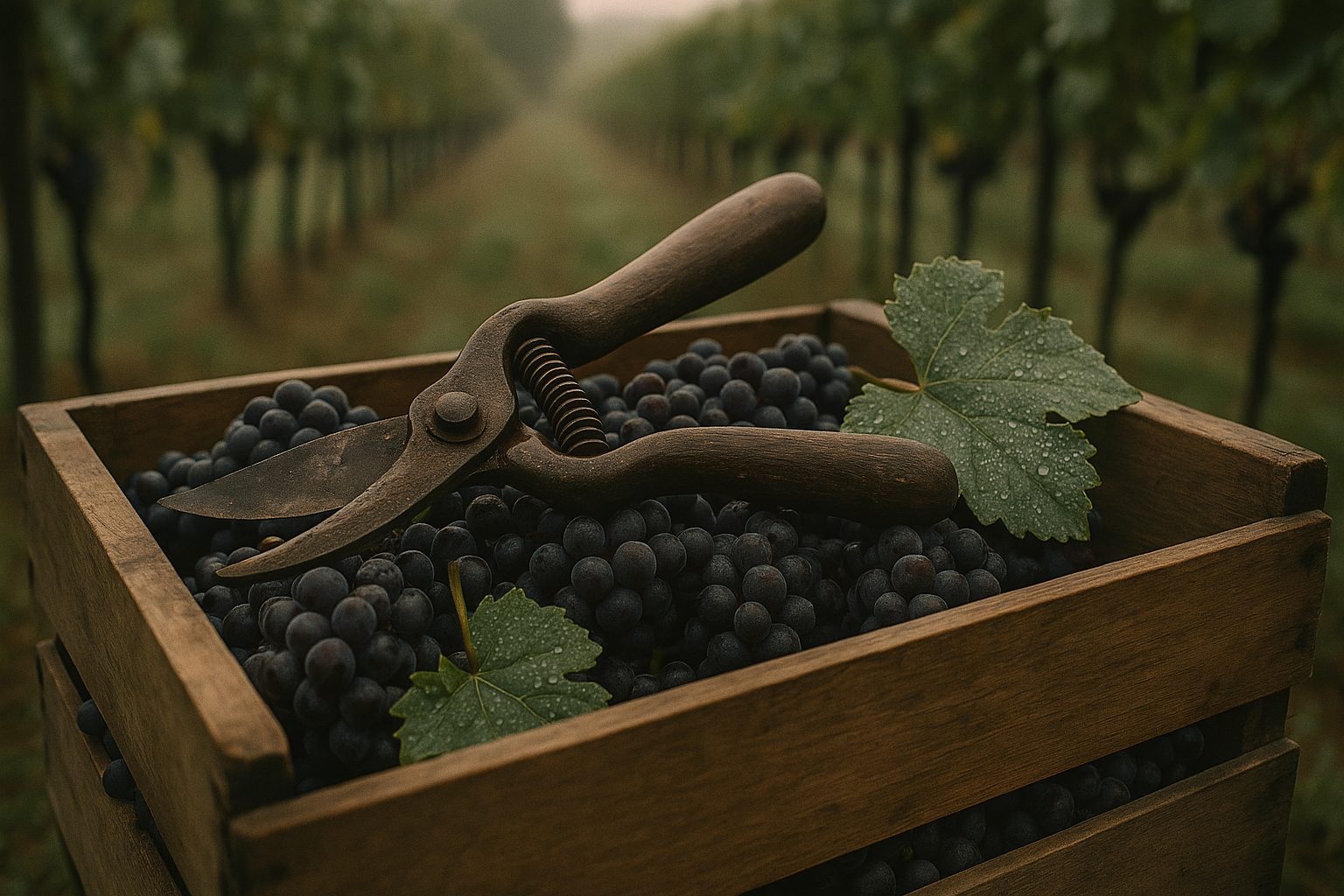
Wine harvest in Burgundy refers to the grape picking that takes place between late August and late September across the region's 31,679 hectares declared in production in 2024, distributed among 84 appellations, including 33 Grands Crus and 562 climats classified as Premier Cru. Every year, Burgundy mobilises more than 40,000 seasonal workers to harvest the Pinot Noir and Chardonnay grapes. For wine-tourism enthusiasts, taking part in the harvest is the most immersive experience there is: spending a few days at a domaine, cutting bunches with pruning shears, sharing meals with the team and witnessing the birth of a great wine first-hand. The good news: no diploma or prior experience is required, but a few rules govern the adventure. Here is everything you need to know before grabbing your basket.
When does the harvest take place in Burgundy?
Burgundy harvests traditionally span late August to late September, depending on grape ripeness and the vintage. Due to climate change, dates have moved forward by two to three weeks over the past fifty years. In 2025, the first cuts started as early as 18 August for the grapes destined for Crémant de Bourgogne, followed around 23-25 August by Chardonnay in the Côte de Beaune, then Pinot Noir around 27-28 August. The order follows a precise logic: sparkling-wine grapes first (Crémant, harvested slightly before full ripeness to preserve acidity), then Chardonnay for the great white cuvées, and finally Pinot Noir. For 2026, official dates will be announced in August by the Bureau Interprofessionnel des Vins de Bourgogne (BIVB) after consultation with growers. Plan on an 8- to 15-day harvest window per domaine.
How to register as a harvest worker
Several channels lead to a harvest job in Burgundy. Local France Travail offices (formerly Pôle Emploi) centralise listings from July onwards. The ANEFA Bourgogne-Franche-Comté, the national association for employment and training in agriculture, publishes the list of recruiting estates on its regional portal. Specialised platforms such as vendangeur.com, vitijob.com and vitabourgogne.com put winegrowers and seasonal workers in touch, free of charge. Finally, the most effective approach remains direct contact with a domaine: a courteous email sent in June or July, briefly outlining your motivation, is often enough to secure a place, particularly if you already know the region.
Since 2024, the « Vendanges étudiantes » programme has streamlined matching between motivated students and Burgundy estates. It is especially suited to candidates without experience and helps finance the start of the academic year while offering an insider's view of the trade. Registrations usually open in spring through CROUS offices and student job platforms.
The harvest contract: what the law says
The contrat vendanges is a unique form of fixed-term seasonal contract, governed by Article L. 718-4 et seq. of the French Rural Code. Its duration is capped at one month, renewable without a waiting period within an overall limit of two months. A unique feature in French law: it can be signed by civil servants, salaried employees on holiday or grant-funded students, without affecting their main status. In terms of pay, the minimum wage is the SMIC horaire (€12.02 gross as of 1 January 2026), often topped up by agricultural collective agreements. On top of that comes the compensatory paid-leave allowance (10 % of total gross), paid at the end of the contract. In practice, for around ten days of work, a harvest worker earns on average €750 to €900 gross in Burgundy.
If the domaine does not provide meals, it must pay a meal allowance of about €7.30 per day. Conversely, a « nourri-logé » (board and lodging included) contract usually deducts around €20 per day from the salary to cover food and accommodation. Housing standards are regulated: at least 6 m² per person, no more than seven workers per dorm, one washbasin for every six workers and one toilet for every eight. Workers can also apply for the seasonal agricultural housing allowance from the MSA, worth up to €600, which covers part of the temporary accommodation costs.
A typical day in the vineyard
Days start early, generally between 6 and 7 a.m., to make the most of the cool morning hours and preserve grape quality. After a quick breakfast, the team heads into the vines. The cutters detach the bunches with pruning shears; the porters empty the baskets into the hod or the crates and carry them to the trailer. The mid-morning break, often around 9:30 a.m., is sacred: bread, cheese, charcuterie and sometimes a glass of Aligoté. Harvesting usually ends around 3 p.m., freeing up the afternoon. Be in decent physical shape: you stay bent over, in sunshine or rain, and the pace is brisk on Premier Cru and Grand Cru plots, where each bunch is sorted by hand straight from the vine.
In Burgundy, roughly 95 % of Grands Crus are hand-harvested. The fragility of Pinot Noir, the need to sort directly at the vine and the local terroir culture explain this choice. Mechanical harvesters are legally banned only in some regions (Champagne, carbonic-maceration vineyards), but in Burgundy the Grand Cru growers have long pushed to outlaw them on the 33 top climats, to protect the image of excellence. For the would-be harvester, this means that on the 562 Premier Cru climats and 33 Grands Crus, the hand still rules, and it is precisely there that the 40,000 seasonal workers Burgundy needs each year are sought, to bring in the crop before the rains.
Paulée and Saint-Vincent: the traditions of the vineyard
At the end of the harvest, Burgundy estates uphold the paulée, a banquet offered by the winegrower to the team to mark the close of the vendanges. The name comes from the « last shovelful » of grapes poured into the press. The most famous, the Paulée de Meursault, was instituted in 1923 by Jules Lafon, then mayor of Meursault, who invited 35 friends to a banquet at the village château. Together with the Vente des Hospices de Beaune wine auction and the Chapter of the Chevaliers du Tastevin, it forms one of the Trois Glorieuses, the three days that crown the Burgundy calendar each year on the third weekend of November. Every guest brings their own bottles to share, creating unlikely tastings where ancient vintages meet wines from around the world.
The other major moment for Burgundy growers is the Saint-Vincent Tournante, which honours the patron saint of winemakers. Revived in 1938 by the Confrérie des Chevaliers du Tastevin, it takes place on the last weekend of January and moves to a different village each year, turning a single wine-growing community into a popular two-day stage for Burgundian tradition. It has no direct link to the harvest itself, but it is an integral part of a winegrower's life and reflects the cohesion of a community that gathers around its terroir.
Practical tips for living the 2026 harvest
A few concrete recommendations before you set off: apply early (ideally June-July, places fill quickly), bring clothes resistant to brambles and to the indelible purple stains of grape juice, closed and waterproof shoes, gloves (winegrowers rarely provide them), a hat and sunscreen. If you can, bring a sharp personal pair of pruning shears, your back will thank you. Warm up your shoulders and back before the first days, and stay hydrated. Insufficient hydration is the most common beginner's mistake.
If you would rather experience the harvest without working full days, as an immersive spectator, several Burgundy estates now offer wine-tourism stays during the harvest, with half-day cutting sessions, must tastings in the winery, meals with the team and overnight stays on site. To rest between days in the vines, Oenosuite offers two premium wine suites in the heart of Dijon, an ideal base to explore the Côte de Nuits and Côte de Beaune, enjoy a Jalunia connected cellar in the evening and return to real urban comfort after the harvest. Burgundy in September is a spectacle you cannot really tell: you have to live it.
Sources & references
Plan your trip to Burgundy
Book your wine accommodation in Dijon
Luxury wine suite with complimentary blackcurrant liqueur, Jalunia connected cellar and wine tourism experiences.
Book now