Clos de Vougeot: history, terroir and visiting the largest Grand Cru
Simon Stoll
Oenosuite Founder
Clos de Vougeot at a glance: the largest Grand Cru of the Côte de Nuits
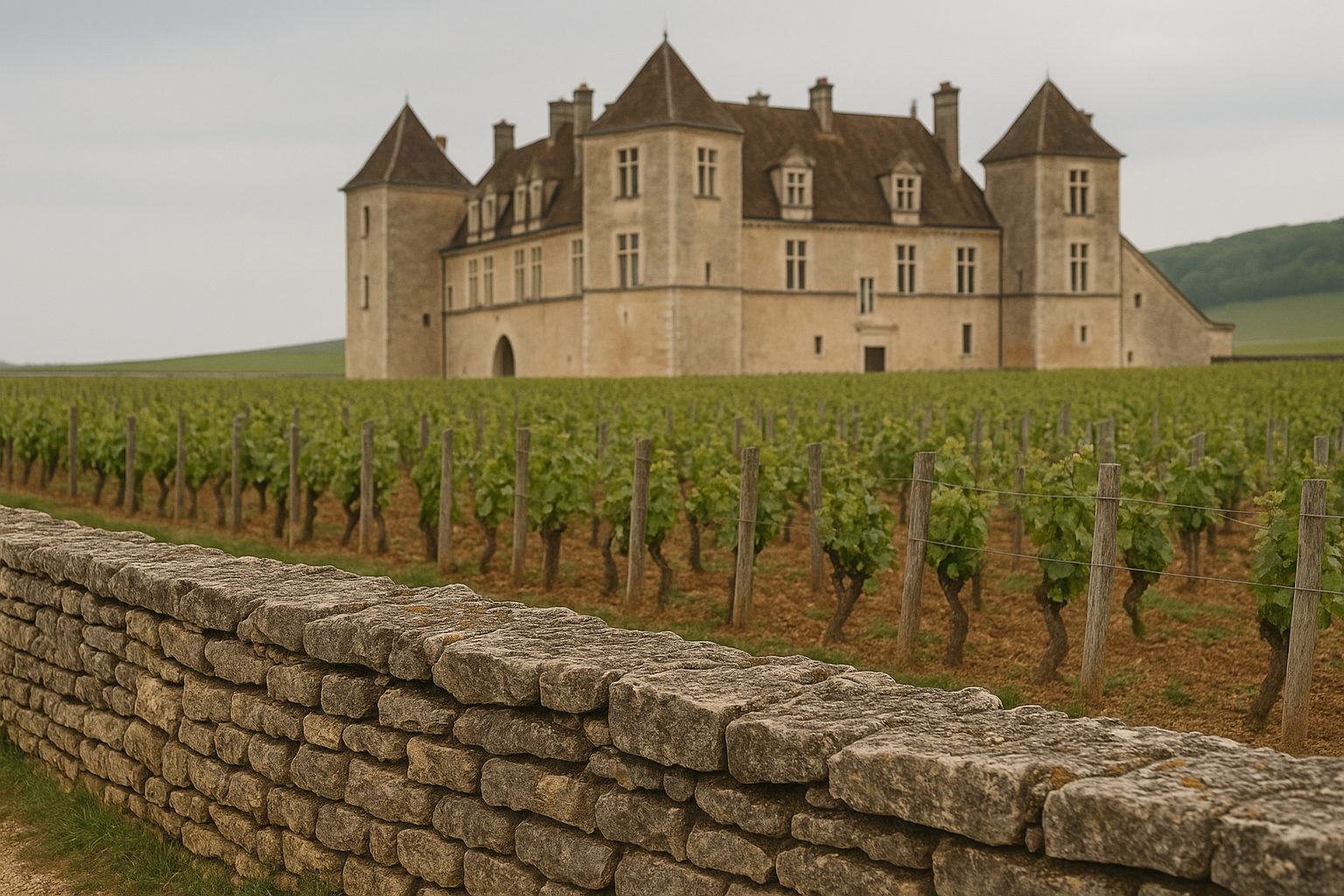
Clos de Vougeot is a Grand Cru of the Côte de Nuits, in Burgundy, producing exclusively red wines from Pinot Noir. As a single unbroken parcel, it covers 50.6 hectares enclosed by a stone wall, making it the largest classified Grand Cru vineyard of the Côte de Nuits. Located in the commune of Vougeot, about 15 kilometres south of Dijon, between Chambolle-Musigny to the north and Vosne-Romanée to the south, it was granted its appellation d'origine contrôlée by decree on 31 July 1937.
Its most striking feature is fragmentation. This single walled clos is today shared among more than 80 owners, spread over roughly 130 parcels, for an average annual production of about 1,730 hectolitres, or nearly 230,000 bottles. In other words, behind a single 'Clos de Vougeot Grand Cru' label hide dozens of very different wines, depending on the parcel and the winemaker's hand: it is arguably the most heterogeneous Grand Cru in all of Burgundy.
Nine centuries of history: from the monks of Cîteaux to the Revolution
The story of the Clos begins in the 12th century, when the Cistercian monks of Cîteaux Abbey gradually assembled, through successive purchases and donations, the land that would form the vineyard. Patient builders, they delimited, planted and progressively enclosed the parcel with a wall, completed around 1336. For almost seven centuries, Clos de Vougeot remained a monastic monopole, farmed as a single block by the monks, who built a press house and a vast cellar on site.
The French Revolution overturned this destiny. Confiscated as a national asset, the Clos was sold at auction in 1791, at first as one block. It then passed through several hands, including those of Julien-Jules Ouvrard, son of Napoleon's financier, before being broken up from 1889 and resold to numerous merchants and growers. It is this gradual fragmentation that explains the mosaic of owners we know today.
The three-tier terroir: the debate that divides enthusiasts
Clos de Vougeot is not a homogeneous terroir, and that is precisely the issue. The vineyard reads in three levels. The upper clos, against the hillside, sits on pebbly, free-draining limestone soils: this is the highest-quality section. The mid-slope keeps good drainage, with an increasing share of clay. The lower clos, close to the old national road (RN 74), is more alluvial and holds more water.
This heterogeneity feeds a recurring debate: many critics argue that only the top and middle of the slope truly merit Grand Cru status, the lower section resembling more of a Premier Cru. A persistent legend holds that the monks reserved the wine from the middle for princes and the pope, the top for visiting bishops, and the bottom for everyday drinking. Quality therefore depends as much on the location of the parcel as on the winemaker's talent: from a great producer, a Clos de Vougeot can be sumptuous; elsewhere, disappointing for its price.
Château de la Tour and the estates to know
Among the forty-odd estates sharing the roughly 80 holdings, Château de la Tour stands apart: with about 5.5 hectares (nearly 12% of the appellation), it is the largest single owner of the Clos, and above all the only estate to harvest, vinify, age and bottle entirely within the walls. Founded in 1890 by the Beaudet family, it has been run since 1986 by François Labet, now alongside his son Édouard, and produces a celebrated 'Vieilles Vignes' cuvée. Other prestigious names share the clos: Domaine Leroy, Méo-Camuzet, Anne Gros, Jean Grivot, Louis Latour and Tollot-Gros, each with its own signature. Comparing two Clos de Vougeot from different growers, from upper and lower parcels, remains one of the most instructive tasting exercises in all of Burgundy.
The Château du Clos de Vougeot: Renaissance jewel and home of the Tastevin
At the heart of the vineyard stands the Château du Clos de Vougeot, a complex built over nearly nine centuries. The press house, with its four great oak-wood presses, was built between 1470 and 1480 (the oldest press dates from 1477). The Renaissance residence, recognisable by its mullioned windows, was added in 1551 by Dom Jean XI Loisier, 48th abbot of Cîteaux. It is today one of the most photographed monuments of the Côte de Nuits.
Since 1944, the château has belonged to the Confrérie des Chevaliers du Tastevin, a wine brotherhood founded on 16 November 1934 in Nuits-Saint-Georges by Georges Faiveley and Camille Rodier to promote the wines of Burgundy. It is here that its lavish chapters are held and, every third weekend of November, the grand gala dinner that opens Les Trois Glorieuses, the highlight of the Burgundian wine calendar.
Visiting Clos de Vougeot: practical tips
The château can be visited year-round. In high season (April to October), it opens daily from 9:30am to 6pm; in low season (November to March), from 10am to 5pm. It is closed on 24, 25 and 31 December and 1 January. The self-guided tour, with a leaflet in French, English and German, lets you discover the medieval press house and its presses; guided tours are available by prior arrangement for a small supplement. The Clos sits directly on the Route des Grands Crus, between Chambolle-Musigny and Vosne-Romanée, easy to combine in a single day.
To taste the wine itself, it is best to go through an estate: Clos de Vougeot cuvées often sell on allocation, from €100 to €300 a bottle at the top producers. A platform like Winalist, an Oenosuite partner, makes it easy to book visits with tastings across the Côte de Nuits. To explore without logistical headaches, oenosuite.fr offers Dijon-based stays designed for wine lovers — wine-themed suites, a connected cellar and themed tastings — less than thirty minutes from Clos de Vougeot, an ideal base for exploring the Grand Crus of the Côte de Nuits.
Sources & references
Plan your trip to Burgundy
Book your wine accommodation in Dijon
Luxury wine suite with complimentary blackcurrant liqueur, Jalunia connected cellar and wine tourism experiences.
Book now