Historic Cellars of Beaune: 7 Must-Visit Wine Caves
Simon Stoll
Oenosuite Founder
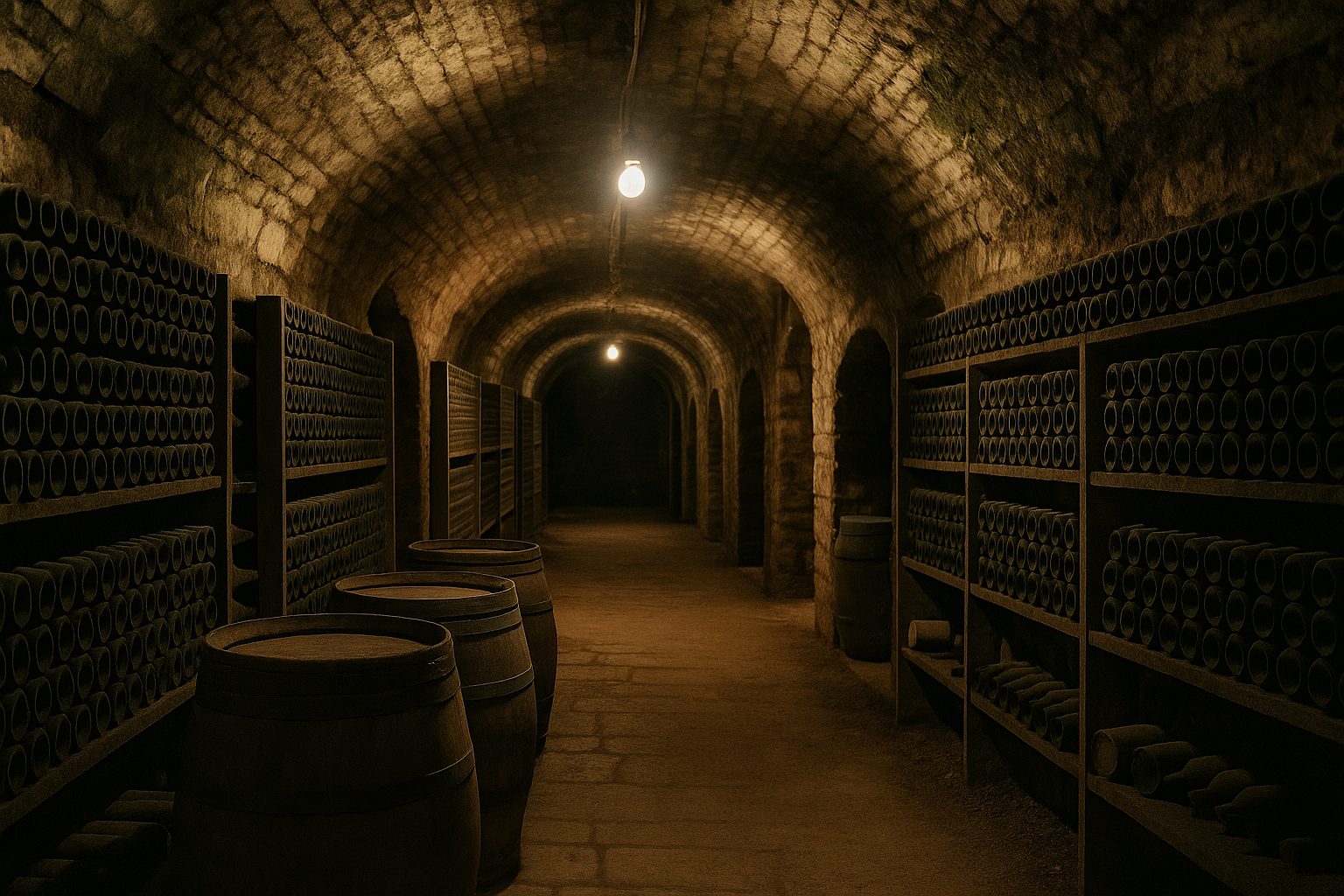
Beaune is the historical capital of Burgundy wines, where the region's great négociants-éleveurs have been based since the 18th century. Beneath its medieval ramparts run almost 5 kilometres of vaulted cellars, the legacy of former convents and city fortifications repurposed after the French Revolution. Today, half a dozen historic houses open their galleries to the public, and a major wine museum joined the line-up in 2023. Here are the seven visits to plan to truly understand Burgundy.
Why Beaune holds so many historic cellars
In the Middle Ages, monasteries and abbeys owned most of the Burgundy vineyards, received as donations. The religious buildings and the city ramparts of Beaune offered cool, stable cellars, perfect for ageing wine. During the French Revolution, these properties were sold as national assets: wine merchants snapped them up en masse in the 18th and 19th centuries and used them to set up their négociant houses. Some galleries date from the 13th century; others rest on Roman walls from the 4th century, as at Joseph Drouhin.
The result: Beaune is probably the only city in the world where, in a single day on foot, you can descend into medieval, monastic and Roman cellars, all still in commercial use today.
Maison Champy (1720): the oldest house in Burgundy
Founded in 1720 by Edme Champy, a former cooper, Maison Champy is officially the oldest négociant-éleveur in Burgundy still in business. Its buildings in central Beaune are listed as Historic Monuments. It is here that Louis Pasteur carried out, with Claude Champy, part of his pioneering work on wine pasteurisation in the 19th century, original equipment from that period is still visible. The tour walks through cellars from several centuries and ends with a tasting of the house wines, including an internationally praised Corton-Charlemagne.
Bouchard Père & Fils (1731): the cellars of the Château de Beaune
Founded in 1731, Bouchard Père & Fils bought its first vineyards in Volnay and Pommard as early as 1775. But it was in 1820, when Bernard Bouchard became owner of the Château de Beaune, that the house anchored itself for good inside the city's fortified walls. The château, built in the 15th century under Louis XI, today houses around 4,000 m² of underground galleries, with walls reaching seven metres thick in places. The estate keeps an exceptional collection of around 2,000 bottles from the last century. Guided visits, Tuesday to Saturday at 2:30 pm, take up to twelve people some ten metres underground, followed by a tasting of six wines.
Patriarche Père & Fils: the largest cellars in Burgundy
This is the cellar for those who love big numbers. Jean-Baptiste Patriarche moved to Beaune in 1780 and acquired the Couvent des Visitandines on 23 August 1796, whose galleries immediately served as cellars. After World War II, André Boisseaux bought some thirty neighbouring cellars and linked them together, creating 5 kilometres of vaulted galleries with 2 million bottles ageing inside. Patriarche today welcomes around 65,000 visitors a year. The « Liberté » self-guided format lets you wander the cellars with an audio guide and taste six great Burgundy wines. A contemporary art trail runs through certain galleries, a nice bonus.
Joseph Drouhin: stepping into a 4th-century Roman wall
The family house Joseph Drouhin, founded in 1880, is set near the Notre-Dame Collegiate Church, on rue d'Enfer. What makes the visit unique is the cellars themselves: they lean on Roman walls from the 3rd-4th century, including a herringbone-patterned section identified as a fragment of the Aurelian Wall built between 372 and 377. The oenothèque stretches over more than one hectare. During World War II, Maurice Drouhin, a resistance fighter, escaped the Gestapo through a door in the quarries and a tunnel leading to the Hospices de Beaune. Visits are by appointment and end with a tasting of six house cuvées.
Maison Louis Jadot: next to the Couvent des Jacobins
Louis Henry Denis Jadot founded the house in 1859 in the historic centre of Beaune, a stone's throw from the Couvent des Jacobins (1475). The family had already been growing vines since 1826, after acquiring the Premier Cru Les Ursules. Since 2013, the house has opened its winery and cellars to individual visitors, with an attached sales space. The building, partly contemporary but firmly rooted in its history, illustrates how Beaune's houses kept reinvesting in the city centre throughout the 20th century. The flagship « Couvent des Jacobins » range pays direct tribute to this monastic heritage.
Marché aux Vins: the Cordeliers church turned cellar
If you want to taste many wines in a single visit, the Marché aux Vins has been open since 1976 inside the former Cordeliers church, built between the late 13th and early 15th centuries. The basement now serves as cellars, where old vintages have been resting for over forty years. Upstairs, three chapels (Saint-François, Saint-Antoine, Saint-Sébastien) remain intact. The ground floor offers a 500 m² space dedicated to Burgundy wines, with more than 2,000 bottles on sale. Tasting packages run from 3 to 7 wines, daily from 10-11 am and 2-5 pm.
Cité des Climats et vins de Bourgogne: the newest addition (2023)
Inaugurated on 17 June 2023 after eighteen months of construction, the Cité des Climats et vins de Bourgogne in Beaune is the region's new museum benchmark. It is part of a network of three sites (Beaune, Chablis and Mâcon, the last two opened in May 2023). The 90-minute immersive tour combines visual, tactile, olfactory and sound installations around the 1,247 climats of Burgundy, inscribed on the UNESCO World Heritage list since 2015. The visit ends with a guided tasting of two wines. It is the ideal introduction for visitors new to Burgundy or anyone wanting to grasp the concepts of climat, lieu-dit and terroir before heading to a grower's cellar.
Practical tips for chaining the visits
A single day in Beaune realistically allows for two or three cellar visits, no more, if you want to enjoy the tastings without palate fatigue. Start with the Cité des Climats in the morning (90 min, ideal to understand the vineyard), follow with a large négociant cellar in the afternoon (Patriarche or Bouchard), and finish, if you still feel sharp, with a tasting at the Marché aux Vins. Book Joseph Drouhin and Louis Jadot well in advance: those visits are by appointment and fill up fast. Avoid the Hospices de Beaune weekend (3rd weekend of November) if you want quiet, the town is saturated.
To move easily between Beaune and the other wine villages, oenosuite.fr offers high-end suites in Dijon, about thirty minutes from Beaune via the A6 motorway or the main road. It is a comfortable base to combine a day of Beaune cellars, a day on the Route des Grands Crus in the Côte de Nuits and a day in Meursault or Puligny-Montrachet, without changing accommodation.
Sources & references
Plan your trip to Burgundy
Book your wine accommodation in Dijon
Luxury wine suite with complimentary blackcurrant liqueur, Jalunia connected cellar and wine tourism experiences.
Book now