Bourgogne Aligoté: the underrated grape that deserves your attention
Simon Stoll
Oenosuite Founder
Aligoté, Burgundy's overlooked grape
Bourgogne Aligoté is a regional Burgundy appellation producing dry white wines exclusively from the Aligoté B grape variety. Officially recognised by decree on 31 July 1937, the appellation covers approximately 1,562 hectares across the departments of Yonne, Côte-d'Or and Saône-et-Loire. Long confined to the unglamorous role of Burgundy's secondary variety, Aligoté has been experiencing a spectacular resurgence in recent years: the AOC gained more than 285,000 bottles over the first eight months of 2024 compared to 2023, a growth of +11.2%.
Aligoté is often described as the Cinderella of the Burgundy vineyard. Planted on less well-exposed plots, too acidic or too cool for noble Pinot Noir or sovereign Chardonnay, it was long considered an unpretentious thirst-quencher. That reputation still clings to it occasionally, but it is increasingly undeserved. Since the 1990s, a new generation of winemakers has championed Aligoté for what it truly is: a variety of character, mineral-driven, taut, refreshingly crisp, and capable of ageing for ten years or more in the cellar.
Bouzeron: the only 100% Aligoté appellation
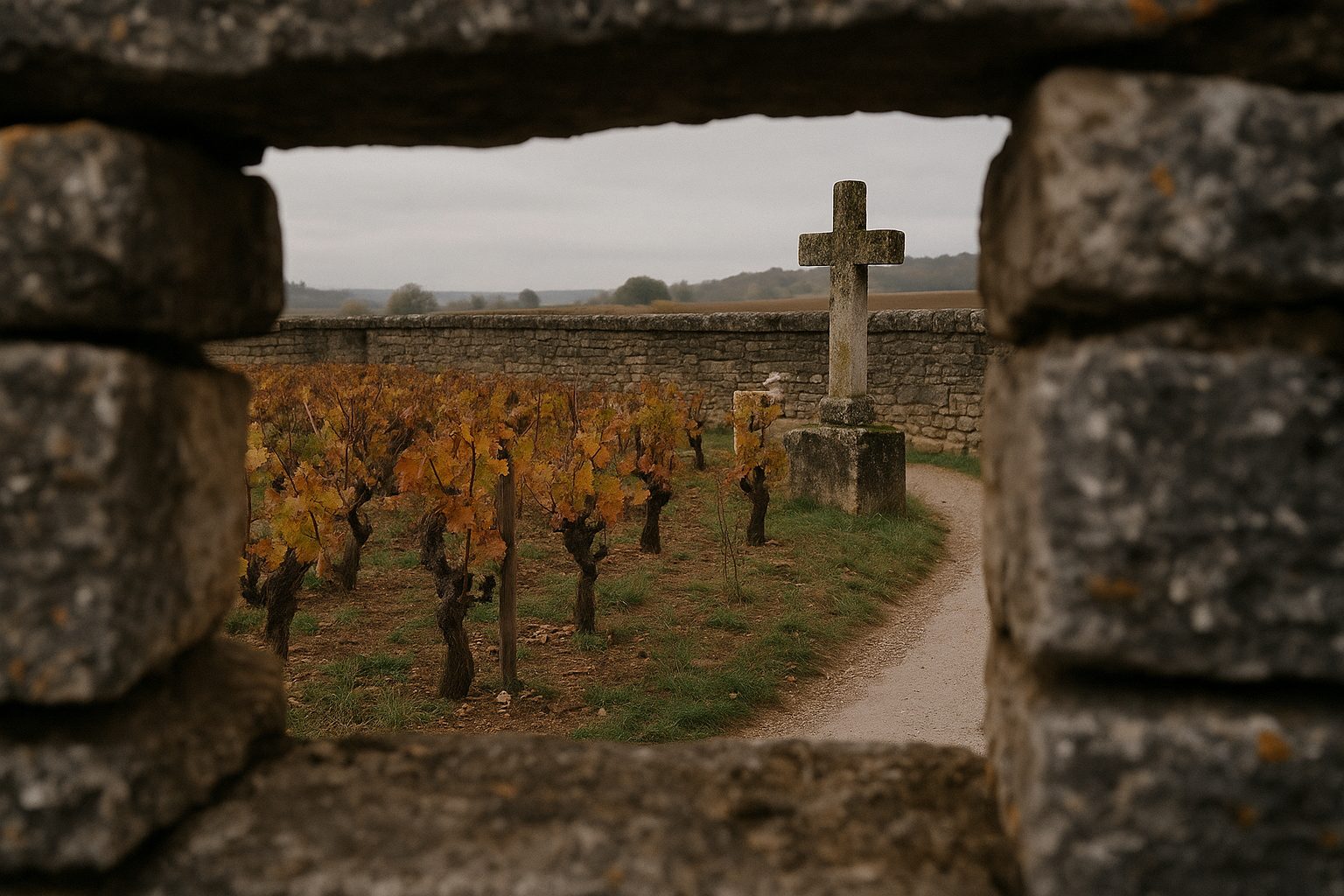
Among Burgundy's 44 wine-growing villages, Bouzeron holds a unique position: it is the only one with a village appellation dedicated entirely to Aligoté. This small village in the Côte Chalonnaise, situated between Santenay to the north and Rully to the south, has barely sixty hectares of vines. The designation was first recognised in 1979 as 'Bourgogne Aligoté de Bouzeron', before being elevated to full AOC Bouzeron status in 1997. This promotion owes much to the determination of Aubert de Villaine, co-founder and long-time co-manager of the Domaine de la Romanée-Conti, who settled in Bouzeron in 1971 with his wife Pamela. Domaine A. et P. de Villaine has practised certified organic farming since 1997 and a biodynamic philosophy, a level of rigour that explains the remarkable quality of their Bouzeron wines.
Kir: the cocktail that made Aligoté famous
If Aligoté enjoys any degree of global recognition, even a diffuse one, it is largely thanks to the Kir. This emblematic cocktail combines blackcurrant cream (crème de cassis) from Dijon with Bourgogne Aligoté. The original recipe, as popularised, called for one part crème de cassis to two parts Aligoté, the sweetness of the cassis tempering the grape's natural acidity. Today, the common proportion is one fifth cassis to four fifths wine.
The Kir's story traces back to an anecdote from 1904 at the Café Montchapet in Dijon, where a waitress supposedly mixed white wine accidentally into a glass of crème de cassis. The resulting drink, then called 'blanc-cassis', allegedly won over the regulars. It was Canon Félix Kir (1876-1968), priest, deputy for Côte-d'Or and mayor of Dijon from 1945 to 1968, who gave it his name. A great enthusiast of the drink, he served it at every official reception. In 1951, the house of Lejay-Lagoute, which had created Dijon's crème de cassis in 1841, was authorised by the canon to use his name in advertising.
The winemakers elevating Aligoté
Aligoté's revival is the result of winemakers who refused to treat it as a second-tier variety. In Marsannay, in the Côte de Nuits, Domaine Sylvain Pataille (founded 1999, 15 hectares) is one of the most compelling champions of the grape. A trained oenologist, Sylvain Pataille offers several Aligoté expressions including the 'Champ Forey' and 'La Charme aux Prêtres' cuvées, vinified with the same care as the great white wines of the Côte de Beaune. The estate practices certified organic farming.
In the Yonne, the Goisot family (Guilhem and Jean-Hugues Goisot) produces a high-quality Bourgogne Aligoté from old vines on the hillsides of Saint-Bris-le-Vineux. In the Côte Chalonnaise, Domaine P. et M. Jacqueson in Rully ranks among the benchmark producers for the appellation. Further north in Nuits-Saint-Georges, Charles Lachaux has launched a highly sought-after limited cuvée called 'Les Champs d'Argent'. What unites these producers is their treatment of Aligoté as a serious variety: controlled yields, aged vines and careful ageing, and their wines prove the point convincingly.
Aligoté and climate change: an unexpected advantage
In the context of climate change, Aligoté possesses an advantage few anticipated: its naturally high acidity. While Chardonnay loses freshness in hot vintages and some winemakers resort to acidification, Aligoté naturally retains its vibrancy. More resistant and more productive than Chardonnay, it reaches a balanced maturity even in warm years, producing wines that maintain their tension and digestibility. Hot vintages such as 2022 and 2023 produced Bouzeron and Bourgogne Aligoté of unusual richness, while retaining the defining acid backbone. Some growers on the Côte d'Or are even beginning to experiment with Aligoté plantings on plots previously devoted to Chardonnay, a quiet revolution worth watching.
Food pairings: Aligoté's hidden potential at the table
Aligoté is a remarkably versatile food wine. Its freshness and minerality make it the ideal partner for oysters and seafood, a pairing that is less predictable than Muscadet but often preferred by seasoned tasters. Its vibrancy cuts through the richness of shellfish and enhances their briny notes. At the table, it also pairs superbly with grilled or poached fish, fish terrines, fresh goat's cheeses (wonderful with a Crottin de Chavignol) and summer aperitifs. For a fully Burgundian experience, start your meal with a properly made Kir, one third crème de cassis from Dijon, two thirds chilled Aligoté, no ice, then continue with the same wine alongside Burgundy snails in parsley butter: a classic pairing that deserves to be rediscovered.
Discovering Aligoté on a wine tourism stay in Burgundy
For curious wine tourists, Aligoté offers an affordable entry point into the Burgundy universe. A quality bottle of Bourgogne Aligoté from a serious producer can be found for between €10 and €15, and a reputable Bouzeron for between €15 and €25, prices that bear no comparison with the stratospheric costs of neighbouring appellations. From Dijon, the ideal base for exploring the vineyard, you can reach Bouzeron in under thirty minutes along the wine route. A visit to Sylvain Pataille in Marsannay or a tasting session in the Côte Chalonnaise is essential for any serious wine enthusiast. Oenosuite in Dijon, bookable at oenosuite.fr, offers accommodation designed for wine lovers: a Jalunia connected cellar to choose your evening bottles, and access to a network of partners including Winalist for booking estate visits, the perfect base from which to explore Burgundy's Aligoté in all its diversity.
Sources & references
Plan your trip to Burgundy
Book your wine accommodation in Dijon
Luxury wine suite with complimentary blackcurrant liqueur, Jalunia connected cellar and wine tourism experiences.
Book now