Bringing Burgundy Wine Home: The Mistakes to Avoid
Simon Stoll
Oenosuite Founder
Bringing Burgundy wine home means transporting bottles bought at the estate all the way to your door without damaging the wine or breaching the rules of your destination country. Three factors decide the outcome: temperature, vibration and the customs allowance that applies to you. A wine that has spent six hours in a 45 °C boot cannot be rescued; a case seized by UK customs cannot be recovered. Here are the six most common mistakes, and the method for getting home with your bottles intact.
Mistake 1: leaving the bottles in the car boot
By far the most expensive mistake, and the most ordinary. In high summer, the cabin and boot of a car parked in the sun can exceed 50 °C. Wine starts to suffer above 25 °C: it evolves too fast, loses freshness and picks up cooked, stewed notes. Worse, heat expands the liquid inside the bottle; pressure eventually pushes the cork, which lifts or lets wine seep out. Once the seal is broken, air gets in and oxidation does the rest. The specialist site iDealwine calls it, without exaggeration, an oenological disaster.
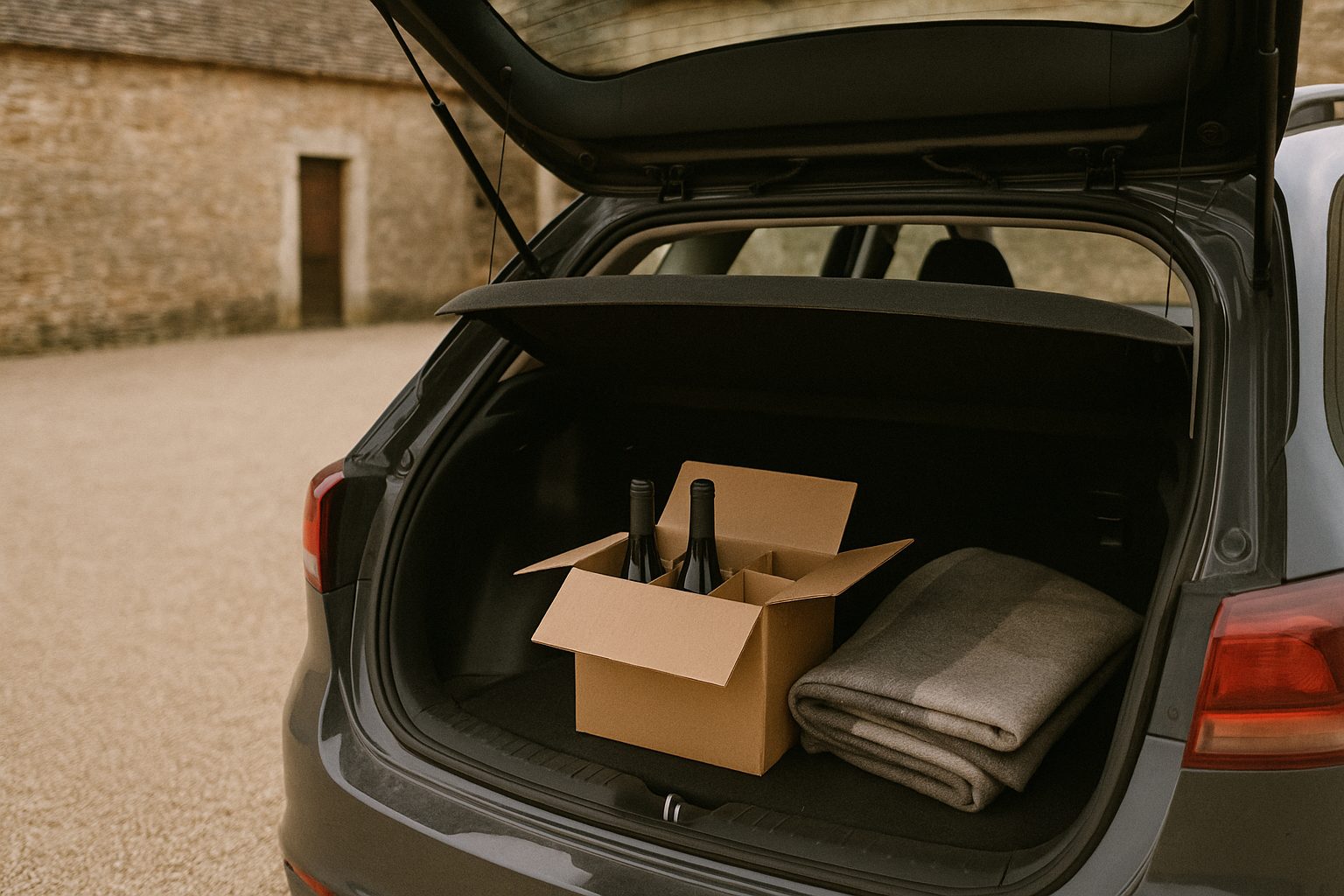
Three habits fix this. Load the bottles last, just before driving home, never first thing in the morning ahead of a full day of visits. Carry them in the air-conditioned cabin, not the boot, which runs hotter and sometimes sits beside the exhaust line. Insulate them: an expanded polystyrene case, a rigid unplugged cool box, or failing that a thick blanket, makes a real difference over a few hours. And never leave bottles overnight in a car, frost in winter being every bit as destructive as heat in summer.
Mistake 2: assuming wine can travel in the cabin
It cannot. The liquids rule caps each container in hand baggage at 100 ml: a 75 cl bottle will never clear security, whatever the label is worth. The only exception is a purchase made in a duty-free shop, handed over in a sealed tamper-evident bag (STEB) with the receipt inside. Be aware that this bag does not always survive a connecting flight: at a second security check, an opened, or merely suspicious, bag is confiscated. If your itinerary includes a stopover, assume the wine travels in the hold. Full stop.
Mistake 3: ignoring the rules for checked baggage
In the hold, IATA rules are clear and work in your favour. Drinks at 24 % ABV or below, which covers every Burgundy, between 12 and 14.5 %, face no quantity limit at all, within your baggage weight allowance. Between 24 % and 70 %, the cap is 5 litres per person (marc de Bourgogne, fine de Bourgogne). Above 70 % ABV, it is banned in both hold and cabin. In every case, bottles must stay in their original, unopened retail packaging.
The real ceiling, then, is the scales. A full 75 cl bottle weighs roughly 1.3 kg: six bottles is close to 8 kg before you even count the carton. On a 23 kg allowance, that leaves little room for anything else. Wrap each bottle in several layers of clothing, packed in the centre of the suitcase, or invest in leak-proof wine sleeves with a double seal, which contain the wine if a bottle breaks. You are saving the whole suitcase, not just the bottle.
Mistake 4: misjudging your customs allowance
Inside the European Union, wine moves freely for strictly personal use, but customs apply indicative levels: 90 litres of wine, of which a maximum of 60 litres may be sparkling, plus 110 litres of beer, 20 litres of intermediate products and 10 litres of spirits. These figures are per adult traveller, not per vehicle. Beyond them, the authorities may presume a commercial purpose and claim excise duty. For a twelve-bottle case, in other words, you are perfectly safe.
Non-EU travellers must pay far closer attention. In the United Kingdom, since 1 January 2021 the allowances are the same whether you arrive from the EU or anywhere else: 18 litres of still wine (24 bottles), plus 4 litres of spirits or 9 litres of drinks below 22 % ABV (sparkling and fortified wines). Mind the trap: if you exceed the limit in one category, duty applies to the entire quantity, not merely the excess. In the United States, the allowance is far tighter: 1 litre per traveller aged 21 or over, for strictly personal use. Beyond that, bottles may still be imported, but duty and federal excise taxes are assessed and collected at the port of entry, and the law of the arrival state applies. An unusual quantity can be reclassified as a commercial import by CBP officers.
Mistake 5: forgetting the VAT refund, or asking too late
If you reside outside the European Union, you can reclaim French VAT on your wine purchases. The conditions are specific: be 16 or over, stay in France for less than six months, and spend more than 100 euros including tax in the same shop over a maximum of three days. The seller issues an electronic VAT refund form (the PABLO system), which you validate at the customs scanning terminal at the airport before checking in your baggage, that is, before the bottles disappear into the hold. The goods must leave the EU within three months of purchase. After the operator's commission, the net refund works out at roughly 12 to 15 % of the gross price.
The detail everyone discovers too late: many small Burgundy estates are simply not set up to issue a VAT refund form. Ask before you pay, not after. The merchant houses of Beaune and the larger tasting rooms almost all offer it; a four-hectare grower rarely does.
Shipping rather than carrying: when does it make sense?
As soon as the volume exceeds a six-bottle case, shipping becomes the rational option. Most estates and wine merchants work with carriers equipped with approved packaging: TNT runs a dedicated wine and spirits service, Chronopost sells its Chrono Viti solution with inserts for 1, 2, 3 or 6 bottles, and specialists such as Expedeasy supply double-wall cartons with reinforced dividers. For shipments to the United States or Asia, use a specialist freight forwarder who understands excise duties, accompanying documents and each country's customs quirks: a poorly documented shipment simply sits blocked in customs. Always weigh the freight cost against the value of the wine: on entry-level bottles, shipping can cost more than the case; on Premiers Crus, it is cheap insurance.
Mistake 6: opening the bottle the moment you get home
You are back, and you want to relive the emotion of the tasting at the estate. It is the surest way to be disappointed. A wine shaken by hours on the road or in an aircraft hold goes through what the trade calls bottle shock, or bottle sickness: the aromas shut down and the wine tastes flat, hard, mute. The good news is that the phenomenon is entirely reversible. Simply let the bottles rest for 8 to 15 days minimum, ideally three to four weeks, lying down, undisturbed, away from light and at a stable temperature (12 to 14 °C). For an old vintage, allow several months. If you are truly in a hurry, two hours in the fridge before bringing the wine back to serving temperature helps stabilise it, but it is a stopgap, nothing more.
What actually works: buy at the end of the trip
Everything gets easier if you reverse the usual order. Visit first, buy afterwards. Concentrate your purchases on the final day, always ask the grower for a divided carton (they always have some), photograph the labels so you remember who sold you what, and keep the invoice: it is the only proof of purchase a customs officer will accept, and the only document that will let you reorder a cuvée from home. And never mix bottles into a bag that also contains a laptop.
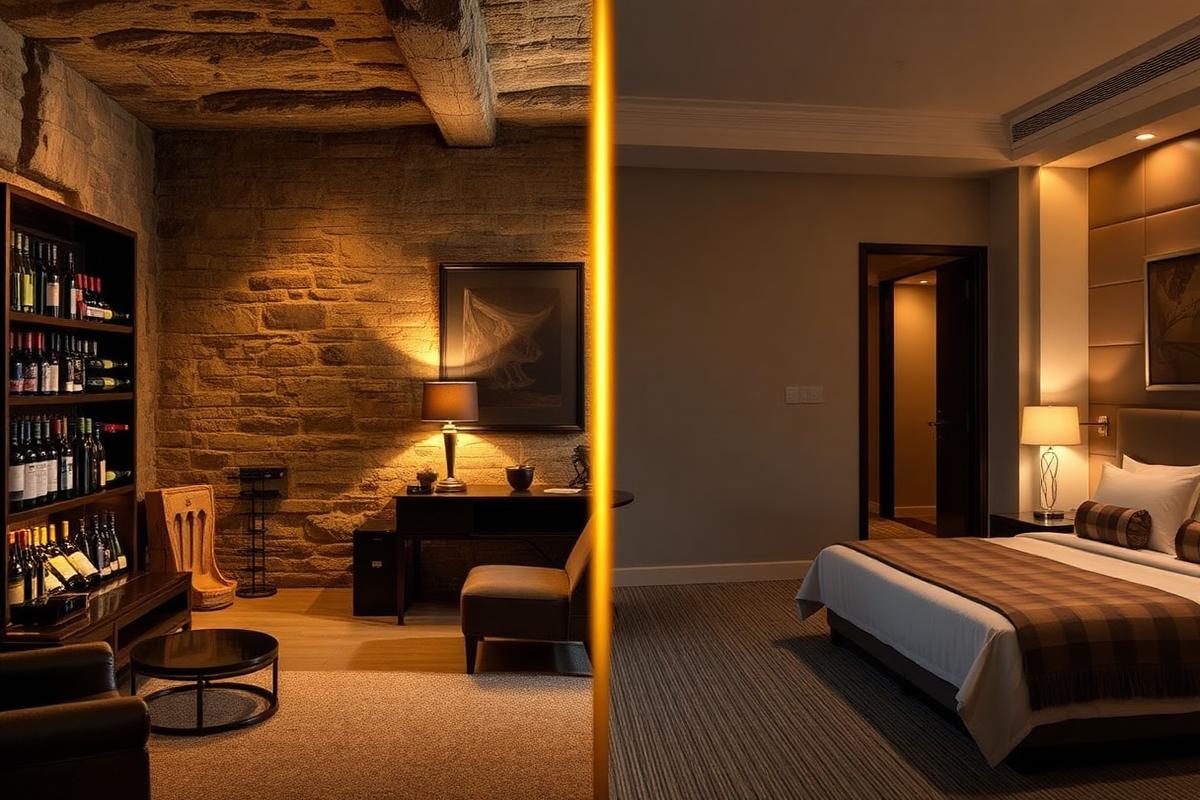
That leaves the question of storage during the stay itself. Three days of tastings across the Côte de Nuits and the Côte de Beaune quickly add up to a dozen bottles waiting, and a car boot is the worst possible place to keep them. Choosing wine-focused accommodation with a cool storage space solves it: oenosuite.fr offers two wine-dedicated suites in the very centre of Dijon, an ideal base from which to explore the Route des Grands Crus, keep your purchases cool and head home with bottles that never saw the sun. It is a small detail. It is also, very often, the difference between a great Burgundy and a spoiled souvenir.
Sources & references
- French Customs, Bringing alcohol bought in an EU country back to France
- French Customs, Tax exemption in France for tourists (PABLO)
- GOV.UK, Bringing goods into the UK for personal use
- U.S. Customs and Border Protection, Bringing alcohol into the United States for personal use
- Air France, Alcoholic beverages: prohibited and restricted items
- iDealwine, Transporting wine in summer: beware
- TNT, Wine and spirits delivery
Plan your trip to Burgundy
Book your wine accommodation in Dijon
Luxury wine suite with complimentary blackcurrant liqueur, Jalunia connected cellar and wine tourism experiences.
Book now