Building a Burgundy wine cellar with €500: the practical guide
Simon Stoll
Oenosuite Founder
Building a Burgundy wine cellar with €500 means buying twelve to twenty bottles wisely split between regional, village and one or two affordable Premier Cru appellations, with a clear preference for direct purchase from winegrowers. Burgundy counts 31,679 hectares declared in production in 2024 and 84 appellations spread across four levels, Regional (52 % of production), Village (44 communes), Premier Cru (about 640 climats) and Grand Cru (33 climats, or 2 % of the vineyard), which makes it possible to balance pleasure-now bottles with bottles to age, without exceeding €500. Here is the full method to build a smart starter cellar, from clever appellation picks to storage rules, while avoiding the trap of flashy but empty labels.
Why €500 is a smart budget to start a Burgundy cellar
With €500 in Burgundy, you will not buy Romanée-Conti or Montrachet, that is a given. But you can build 15 to 20 bottles of genuinely good quality, mixing pleasure-now bottles and bottles for the long haul. The key is to drop the cliché that « low price = poor wine » in Burgundy. The Burgundy market has seen an average 25 % rise in release prices on the 2022 vintage according to the Liv-ex report, but regional and Côte Chalonnaise appellations remain very affordable, typically €12 to €30. The golden rule: buy from independent winegrowers rather than generalist merchants, and favour lesser-known villages over star appellations inflated by speculation. The upside of a constrained budget is that it forces you to structure your cellar by use case, avoiding the beginner's mistake of blowing €200 on a single bottle « just to see » and being left with nothing for the next twelve months.
The Burgundy appellation pyramid at a glance
The Bureau Interprofessionnel des Vins de Bourgogne (BIVB) sums up the hierarchy in four tiers. At the base, Regional appellations (52 % of production): Bourgogne, Bourgogne Aligoté, Bourgogne Côte Chalonnaise, Crémant de Bourgogne, Coteaux Bourguignons, at €8-20 per bottle at the domaine. Just above, the 44 Village appellations (Marsannay, Mercurey, Givry, Beaune, Pommard, Volnay, Meursault, Chablis…): €18-50 for most, much more for the star Côte de Nuits villages. Above that, the 640 Premier Cru climats, specific plots named on the label, e.g. Givry 1er Cru « En Veau »: expect €25-80 in the Côte Chalonnaise, €45-150 in the Côte de Beaune, €80-400 in the Côte de Nuits. At the top, the 33 Grands Crus: 550 hectares total, or 2 % of the vineyard, with prices starting at €150-200 and quickly soaring past €1,000. On a €500 total budget, forget Grand Crus and focus on the first three tiers.
The ideal split: 18 bottles for €480
Here is a proven split to structure a balanced starter cellar. Three aperitif bottles (€45): one Bourgogne Aligoté (€12-15 from a good producer) and two brut Crémant de Bourgogne (~€15 average), perfect for spontaneous evenings. Four everyday reds (€60): one Bourgogne Côte Chalonnaise red, for example Domaine de l'Évêché « La Cadole » 2024 at €15, rated 17/20 by the Côte Chalonnaise wine board, and three regional Bourgogne Pinot Noir, to drink within 2-4 years.
Three Hautes-Côtes or Côte Chalonnaise (€66): one Bourgogne Hautes-Côtes de Beaune red (vineyards at 280 to 550 m altitude, 80 % Pinot Noir, fresh and precise at €18-22) and two Mercurey village (around €15 for the 2024 vintage), which will open up over 5-8 years. Three Marsannay reds (€75): the only Burgundy appellation produced in three colours (red, white, rosé), the northern gateway to the Côte de Nuits. Domaine Sylvain Pataille offers its village Marsannay red around €24, with 8-12 years of aging potential. Two well-known villages (€80): an entry-level Beaune or Pommard village at around €40, to keep 5-10 years. One affordable Premier Cru (€30): the cellar's centrepiece. The Givry 1er Cru « En Veau » 2023 from Domaine Deliance retails at €29. Two pleasure / gift bottles (€120): a Chassagne-Montrachet village or an underrated Côte de Beaune Premier Cru (Saint-Aubin, Auxey-Duresses) at €50-65, to age 8-15 years. Total: about 18 bottles for €476.
Smart appellations to favour in 2026
The historical price surge on Gevrey, Chambolle or Vosne-Romanée has a useful side effect: it pushes enthusiasts towards still-reasonable neighbouring villages. Top of the list: Marsannay, long declassified as plain « Bourgogne », promoted to village in 1987, and now lodging a Premier Cru classification dossier for its best climats. Fixin, its immediate neighbour, offers powerful reds at €25-30 a village bottle. On the Côte de Beaune, Saint-Aubin offers Premier Cru whites at €35-50, compared to the €100+ of a neighbouring Puligny-Montrachet Premier Cru. Further south, the Côte Chalonnaise remains the most accessible area: Mercurey (Burgundy's largest village AOC by volume), Givry, Rully and Bouzeron (cru-level Aligoté) deliver excellent value Pinot Noir and Chardonnay, often 30 to 50 % cheaper than their Côte d'Or equivalents. Even further south, the Mâconnais produces precise, mineral Chardonnays at €12-25 for village wines. Lastly, the Yonne (Chablis, Irancy, Saint-Bris) remains under-priced: a Chablis Premier Cru is around €30-40, half the price of a Meursault village.
Choosing the right vintages in 2026: 2022, 2023, 2024
Three vintages are currently in circulation. The 2022 is, according to the BIVB, a vintage that is both qualitative and generous: balanced, expressive reds, ready to drink from 2024-2025 for regional and village wines, and capable of aging to 2030-2032 for the best Premier Cru. For a cellar, it is the « heart » vintage: available, well rated, with a fair quality-to-price ratio. The 2023 is judged excellent by the trade, elegant wines, ripe fruit, melted tannins, generous in volume, and is the one to favour for village wines and Premier Cru meant for long aging. The 2024, on sale since late 2025, is paradoxical: quality is judged very high, comparable to 2010 for reds according to the BIVB, but volumes fell by 50 % on Côte-d'Or reds and 70 % in the Auxerrois, hit by excessive rain (+37 % above the norm) and mildew attacks. As a result: few bottles, but those that exist are concentrated and deep.
Storing your cellar: rules you cannot skip
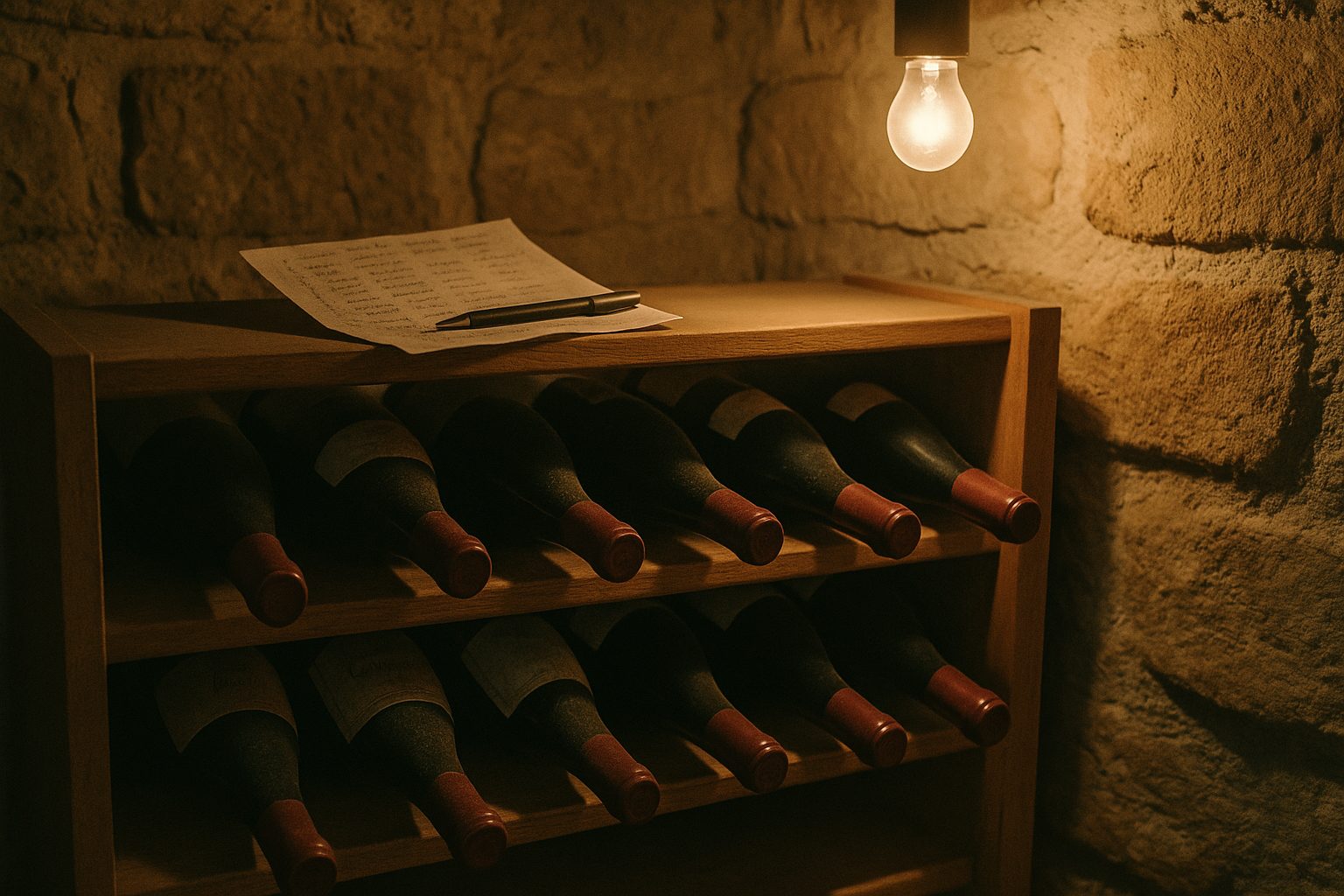
Buying beautiful wines without knowing how to store them means throwing €500 out of the window. Four parameters matter. Temperature: between 12 and 14 °C for Burgundy Pinot Noir, ideally a constant 12 °C; sudden swings are enemy number one. Humidity: between 70 and 75 %, below, corks dry out and wine oxidises; above, labels grow mould. Light: zero direct light, especially sunlight or UV; natural cellars or opaque wine cabinets are essential. Position: bottles lying down, so the cork stays in permanent contact with the wine and keeps its seal. If you do not have a natural cellar, a wine storage cabinet of 50 to 100 bottles (€600-1,200 for a good brand) is more than enough for a starter cellar. Avoid the garage or the attic: too hot in summer, too cold in winter. Keep a logbook (paper or apps like Vivino, CellarTracker) with purchase date, price paid, and drinking window, otherwise you will open your best bottles too early, or worse, too late.
Where to buy: winegrower, wine shop, en primeur
Three main channels. Buying directly from the winegrower remains the best route in Burgundy: you skip the merchant and distribution margins, you discover the domaine's philosophy, you sometimes get access to confidential cuvées, and you build the relationship that opens future allocations. Plan a day for 3-4 domaines (and remember to spit if you are driving). The specialist local wine shop is the second channel: it selects, advises and offers cuvées that are hard to access if you do not live in the region. The margin is higher (+15 to 30 % above the domaine price), but the service makes up for it. Finally, Burgundy en primeur sales (buy in January-February for delivery 12-18 months later) give access to rare cuvées at release prices, but it is a bet: you must trust the domaine and accept tasting the wine only well after paying for it. For a first €500 cellar, stick to the first two channels.
To explore Burgundy and buy in person, Oenosuite offers two wine-themed suites in the historic centre of Dijon, an ideal base to roam the Côte de Nuits, Côte de Beaune and Côte Chalonnaise over three days, visit five or six domaines, and head home with a thoughtfully built cellar. The Jalunia connected cellar in one of the suites also lets you taste a curated Burgundy selection before committing to your own purchases. oenosuite.fr is here to help you structure that escapade.
Sources & references
Plan your trip to Burgundy
Book your wine accommodation in Dijon
Luxury wine suite with complimentary blackcurrant liqueur, Jalunia connected cellar and wine tourism experiences.
Book now