How Many Days Do You Need to Visit Burgundy? 2, 3 or 5
Simon Stoll
Oenosuite Founder
The Burgundy vineyard stretches roughly 250 kilometres, from Chablis in the north to the southern Mâconnais, and holds 84 protected appellations. The Route des Grands Crus, by contrast, covers just 60 kilometres between Dijon and Santenay. Those two figures sum up the whole problem: you can see the heart of the vineyard in two days, or spend a week without covering it. The real question is not how long you need to visit Burgundy, but which version of Burgundy you want to bring home. This guide breaks a Burgundy trip into three formats — 2, 3 and 5 days — with what each one genuinely allows, what you have to give up, and the travel times to build in. One benchmark before anything else: between two tastings, it is almost never the driving that eats the day, it is the tasting itself. Allow 1.5 to 2.5 hours per estate visit, by appointment in nearly every case.
Two days: a weekend focused on the Côte de Nuits
Two days is the most common format, and it works on one condition: giving up on seeing everything. A well-built weekend sits on a single axis, the Côte de Nuits, between Dijon and Nuits-Saint-Georges. Gevrey-Chambertin, Vougeot, Vosne-Romanée and Nuits-Saint-Georges line up along some twenty kilometres: ten minutes takes you from one village to the next, which leaves room for two estate visits on Saturday and one on Sunday morning without ever chasing your own schedule.
A typical Saturday looks like this: a first tasting late in the morning, lunch in a village bistro, a second tasting around 3pm, then back into town for dinner. On Sunday, bear in mind that many estates are closed — it is the ideal day for the château du Clos de Vougeot, a village market or a walk through the climats. Two days is plenty to grasp the parcel-by-parcel logic of the Burgundy vineyard and to leave with a few well-chosen bottles; it is not enough to add Beaune, Chablis and the Mâconnais on top. Trying to squeeze them in anyway is the one real mistake with this format.
Your base: the choice that saves the most time
On a short trip, the biggest drain on time is neither the driving nor the tastings: it is the shuttle between your accommodation and the starting point of each day. Staying on the outskirts means two round trips a day and a car just to reach dinner. Staying in the town centre means heading straight out in the morning and walking home after dinner — which also settles, incidentally, the question of who drives after a tasting.
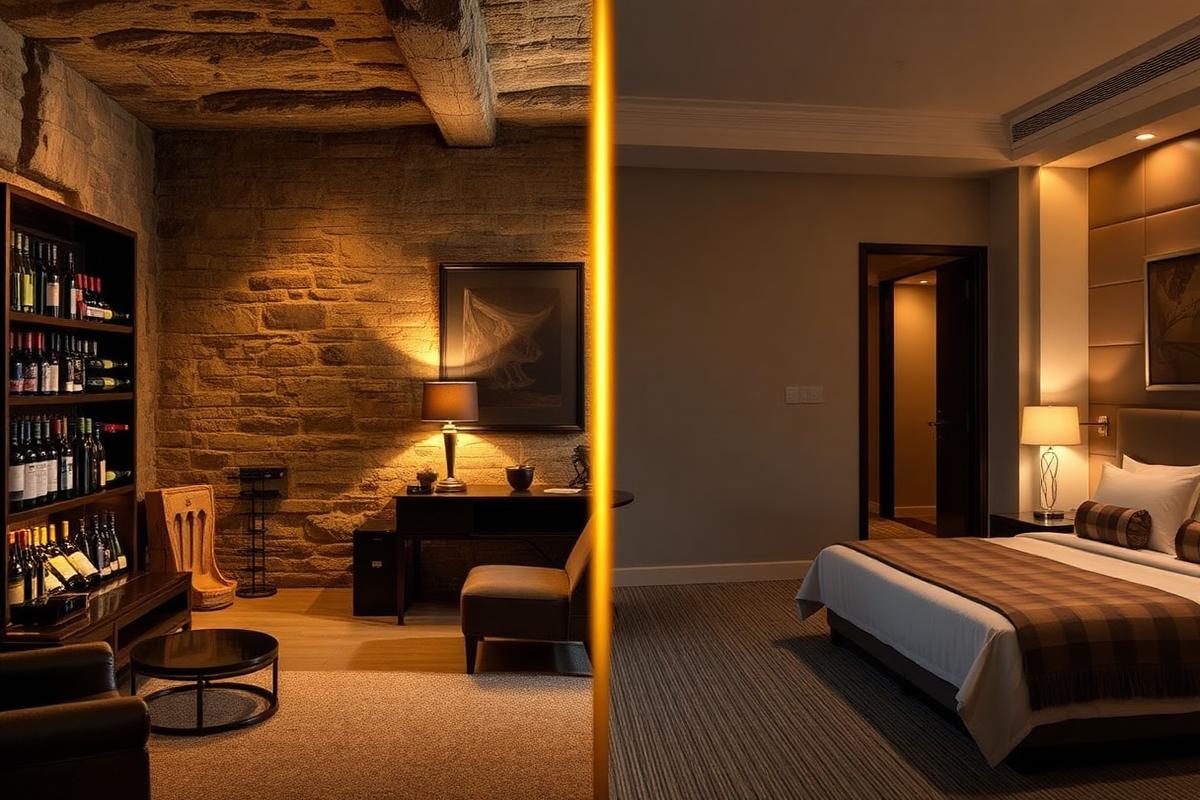
That is precisely the logic behind the Oenosuite in Dijon, a stone's throw from the Palais des Ducs and twenty minutes from the Route des Grands Crus. Two apartments are available: the Suite Charme & Vin (43 m², 2 to 4 guests, exposed stone, cement floor tiles, video projector) and the Loft d'Artiste (25 m², 2 guests, designed by Dijon architect Alexandrine Vaure, raw concrete, water-vapour fireplace, cocoon mezzanine). It is the only apartment carrying the Vignobles & Découvertes label in Bourgogne-Franche-Comté, rated a 3-star Meublé de Tourisme and scored 4.94/5 on Airbnb across more than a hundred reviews. Over two or three days, the real value lies in the included experiences — tasting socks left in the apartment for your own blind tasting, a wine escape game, the Jalunia connected cellar available on demand from the suite, wine games, and a miniature of Dijon crème de cassis on arrival: your evenings are already full, which spares you from overloading your days. Booking directly on oenosuite.fr secures the best rate, with no platform commission (07 50 96 09 18).
And if you are giving this trip rather than taking it? This is exactly where duration becomes a headache: there is no way to guess whether the person will have two days or five, or when. The Oenosuite gift card flips the logic — you choose the amount, the recipient chooses the dates. Preset amounts run from 50 to 300 € (50, 75, 100, 150, 200 or 300 €), with a custom amount possible between 25 and 1,000 €. It is valid for twelve months from the date of purchase, usable on any Oenosuite stay or experience, personalised with the recipient's name and a message, and covered by a 14-day right of withdrawal from the purchase date.
Three days: adding Beaune and the Côte de Beaune
The third day does not lengthen the trip so much as change its nature. It lets you drop down into the Côte de Beaune — Pommard, Volnay, Meursault, Puligny-Montrachet — and above all take in Beaune itself, which deserves a full half-day rather than a quick stop. The Hôtel-Dieu des Hospices de Beaune takes about an hour to walk through, audio guide included, for 12.50 € full price (9.50 € reduced, 6.25 € for ages 6-17), with continuous opening from 9am to 7.30pm between 1 April and 15 November. A few hundred metres away, the Cité des Climats et vins de Bourgogne offers a 1.5 to 2-hour route; its Experience Ticket at 29.50 € combines the route with a tasting workshop and remains valid for two days, so you can spread it across the trip.
The logistical detail that changes everything: Dijon and Beaune are linked by regional train in around twenty minutes, with some fifteen services a day over 34 kilometres. You can therefore devote a full day to Beaune without a car and without choosing between tasting and driving. Over three days, the most efficient split remains: one day on the Côte de Nuits by car, one day in Beaune by train, and a free half-day for an estate you want to revisit or for the town itself.
Five days: widen the map or slow the pace
Beyond three days, two strategies compete. The first is to widen your geography: Chablis sits about 150 kilometres north-west of Dijon, a 1h35 drive, and the Mâconnais lies at the other end of the vineyard. Both excursions are entirely worthwhile — the Chardonnay there gives wines the Côte does not produce — but each swallows a full day, travel included. Five days lets you add one, rarely both. The second strategy, often more rewarding, is to stay put and slow down: two hours with a winemaker instead of one, a walk through the climats rather than a drive past them. The 1,247 climats inscribed on the UNESCO World Heritage list on 4 July 2015 read far better on foot.
A longer stay also allows one day without driving: private full-day excursions from Dijon or Beaune start at around 210 € per person, lunch excluded. That is a genuine budget line, but across five days, a day when nobody is watching their glass is often worth the price. Finally, consider the season, which weighs as heavily as the duration: in September and October, harvest time and peak season, winemakers are out in the vines and slots are scarce — allow an extra day for the same programme. In every case, book two to four weeks ahead, and up to two months for the most sought-after estates.
Two days to understand, three to genuinely taste, five to grow attached: the right duration is the one that leaves time between tastings rather than adding more of them. Getting there barely factors in, since the high-speed train links Paris Gare de Lyon to Dijon in about 1h35 with some fifteen departures a day — leaving on a Friday evening turns a two-day weekend into a two-and-a-half-day trip, which in Burgundy means one more estate visit. Whichever format you choose, a base in the town centre removes the pointless journeys and makes the evenings as interesting as the days: that is what the Oenosuite offers, bookable directly on oenosuite.fr. And if this trip is meant for someone else, the gift card lets them pick their own duration.
Sources & references
Plan your trip to Burgundy
Book your wine accommodation in Dijon
Luxury wine suite with complimentary blackcurrant liqueur, Jalunia connected cellar and wine tourism experiences.
Book now