Rare Burgundy Grapes: Sacy, César and Pinot Beurot
Simon Stoll
Oenosuite Founder
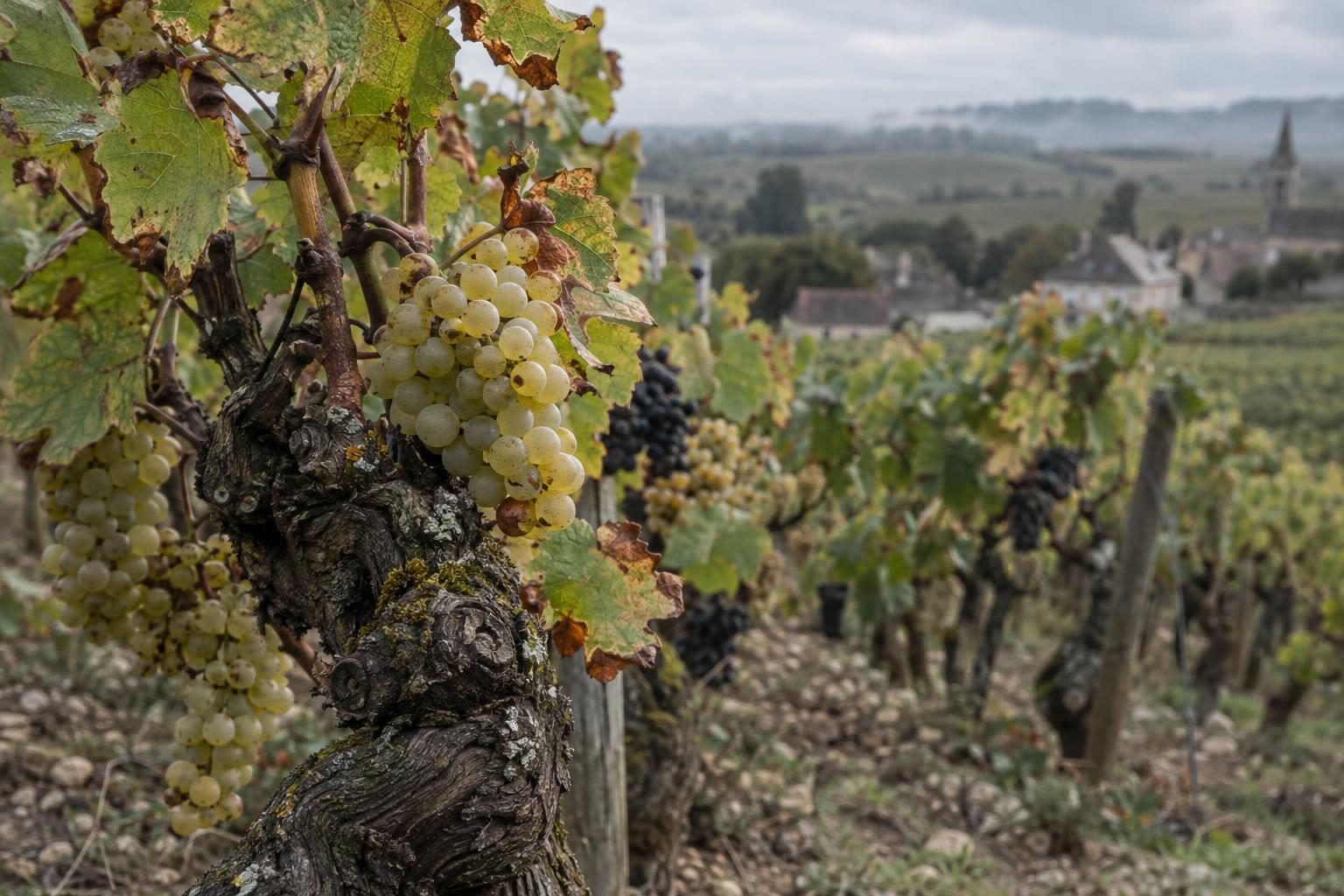
Rare Burgundy grape varieties account, according to Burgundy Report, for at most 0.2% of the region's vineyards: everything else is Pinot Noir and Chardonnay, with a little Gamay and Aligoté. Yet behind this two-grape façade, Burgundy hides old varieties, sometimes only a few hundred vines: Sacy, César, Pinot Beurot, Melon or the Sauvignon of Saint-Bris. Here is what they tell about the vineyard, and how to taste them during a stay.
Why Burgundy has (almost) only two grapes
This near-monoculture is as much a political decision as a wine-growing one. In 1395, Philip the Bold, Duke of Burgundy, banned Gamay in favour of Pinot Noir, judged nobler. Six centuries later, the appellation system froze that choice: for the great wines, reds from Pinot Noir and whites from Chardonnay. The other varieties did not vanish; they were pushed to the margins, to blending corners and to terroirs nobody was looking at.
This marginality has an advantage for the curious traveller: each rare grape is tied to a precise place, an estate, sometimes a single plot. These are not mass-market wines, they are stories of stubborn winemakers. Bringing them into a tasting weekend adds a layer of reading to the vineyard, well beyond the Côte d'Or grands crus that everyone quotes.
Sacy: a nearly vanished white from the Yonne
Sacy is an old white grape from the Auxerrois. Tradition says it was brought from Italy in the 13th century by monks of Reigny Abbey; DNA analyses link it instead to Pinot and Gouais Blanc, an old Burgundian grape, which makes the Italian origin doubtful. In the Loire it is called Tressalier and is mostly used for blending in Saint-Pourçain whites. In Burgundy it is accepted notably in Crémant de Bourgogne and at Chitry. The areas are tiny: Burgundy Report cites a largest plot of 0.3 hectare, at Domaine Gueguen, and a 0.12 hectare planting made in 2018. A Sacy wine is therefore a collector's curiosity, to be sought at Yonne winemakers rather than in a supermarket.
César: the Roman red of Irancy
César is an old red grape that legend says arrived with the Roman legions. It is authorised in the Irancy appellation, where it can complement Pinot Noir up to 10%: beyond that, the wine loses its right to the appellation, Burgundy Report explains. It brings colour, tannin and peppery notes to a cool-climate Pinot Noir. According to a 2021 article, only 10 hectares of César were planted in 2008, a global rarity. It is the textbook case of a grape that makes a village's identity: you cannot taste an Irancy with César without understanding why local growers defend their difference from the Côte d'Or crus, more than an hour's drive away. Our article on Irancy and Saint-Bris details the estates to visit.
Pinot Beurot, Melon, Sauvignon: the endearing outsiders
Pinot Beurot is the ancestral Burgundian name for Pinot Gris. Its first possible mention dates to the late 13th century, at Chassagne-Montrachet, according to Flatiron Wines. It appears discreetly in some blends: Simon Bize puts about 5% in his Bourgogne Blanc, and Chisa Bize has made 100% Pinot Beurot bottlings. Its legal 10% limit in reds is almost never reached.
Melon, the Muscadet grape, is a cross of Gouais Blanc and Pinot Blanc according to DNA studies, and remains permitted in Crémant de Bourgogne, but with a very marginal presence. As for Sauvignon, its only Burgundian stronghold is Saint-Bris: the appellation is the only one in the region whose official grape is Sauvignon Blanc, on Kimmeridgian limestone soils, the same as Chablis. Around 130 hectares were planted there in 2017 according to Burgundy Report. Finally, Gamay, banned in 1395, has come back through the side door: the Coteaux Bourguignons appellation replaced Bourgogne Grand Ordinaire in 2011 and accepts Gamay alone or in blends, and Passetoutgrains requires at least 30% Pinot Noir and 15% Gamay. It is also historically the most unloved grape of the Côte d'Or, which makes the story fun to tell over a glass, and a good reason to ask any winemaker you meet about the varieties they keep in the corner of a plot.
How to taste them during a stay in Burgundy
These wines are rarely found in the cellars of big names. The simplest approach is to go to the winemakers: the Chablis area, the Auxerrois and the Côte Chalonnaise host most of these curiosities. To organise estate visits without scouting yourself, the platform Winalist lists tastings at winemakers across the region. Expect limited quantities: a rare grape can mean 300 bottles in a year, so ask at the estate rather than hoping to find the bottle in a shop afterwards.
A good method is to set up a small comparative tasting at home: a classic Bourgogne Blanc, then a white with Pinot Beurot, then a Saint-Bris. The tasting socks left in the apartment for your own blind tasting at Oenosuite let you play this game yourself, with your own bottles, among friends or as a couple, and see whether you can recognise the Sauvignon by the way Burgundy treats it.
To radiate from Dijon, Oenosuite, the only apartment labelled Vignobles & Découvertes in Bourgogne-Franche-Comté, sits in the historic centre, steps from the Palais des Ducs, with the Route des Grands Crus 20 minutes away. The Jalunia connected cellar, self-service from the suite, offers Burgundy wines to taste at your own pace. Book direct on oenosuite.fr (best rate, no platform commission) or on +33 7 50 96 09 18.
And to give this discovery to a curious wine lover, the Oenosuite gift card solves the dates problem: you choose the amount, from €25 to €1,000 (or presets of €50, 75, 100, 150, 200 or 300), with a personalised message, and the recipient chooses their weekend within 12 months of purchase.
Sources & references
Plan your trip to Burgundy
Book your wine accommodation in Dijon
Luxury wine suite with complimentary blackcurrant liqueur, Jalunia connected cellar and wine tourism experiences.
Book now