Why Burgundy's Greatest Wines Are Sold by Allocation
Simon Stoll
Oenosuite Founder
Allocation: the word that explains why that grand cru is never on the shelf
Allocation is the sales system under which a Burgundy estate sets aside a fixed number of bottles each year for a named list of buyers: independent wine merchants, restaurateurs, importers and, more rarely, private customers. In Burgundy, allocation governs almost every grand cru and every sought-after premier cru. One figure explains why: the 33 Grand Cru appellations of Burgundy cover roughly 550 hectares in total, barely 1 to 2 % of the region's annual output. Looking for one of those bottles on a shop shelf means looking for something that was never put there.
Understanding the mechanism changes how you plan a wine trip to the Côte-d'Or. It saves you three days of ringing doorbells at estates that literally have nothing to sell to a passer-by. More usefully, it points you to the doors that do stay open to an enthusiast without an address book: the négociant houses, the auction room and the wine list by the glass. We go through all three below, after taking the system apart and explaining the economics behind it.
Unforgiving arithmetic: 550 hectares for the entire planet
The Burgundy vineyard covers more than 32,000 hectares in production, roughly 2 % of the French vineyard area and 0.5 % of world wine production, according to BIVB figures. Within that already modest total, Grands Crus account for some 550 hectares, of which about 356 hectares are planted to Pinot Noir and 195 to Chardonnay. At the other end of the chain, Burgundy wines represent close to 4 % of world wine trade by value for 0.4 % of world production. Global demand facing a supply the size of a small district: the imbalance is not a marketing trick, it is structural.
Weather makes the squeeze worse. In 2021, spring frosts cut the Burgundy harvest roughly in half: around 750,000 hectolitres against 1.56 million the previous year. When an estate loses half its volume, it does not delete half its allocation holders. It halves everyone's quantity instead. That is how customers loyal for fifteen years end up with three bottles instead of six, while the waiting list does not move by a single place. Every short vintage freezes the system a little further.
What an allocation really is, seen from the estate
An allocation is not a standard commercial contract but a reciprocal moral commitment, renewed each year. The estate undertakes to reserve a given volume at a price it sets itself; the buyer undertakes to take that volume as a whole, meaning the entry-level cuvées as well as the headline wines. Turning down the regional Bourgogne bottlings two years running in order to keep only the premier cru is the fastest way to vanish from the list the following season.
For the grower, the system solves three problems at once. It secures sales before the wine is even bottled, which gives valuable cash-flow visibility in a trade where one frosty night can erase a year of work. It keeps control of the release price and therefore limits immediate speculation on the estate's own bottles. And it controls distribution: knowing which tables and which shops will serve the wine is as much part of an estate's image as the work done in the vines.
The most discussed case remains the Domaine de la Romanée-Conti. The Romanée-Conti climat covers 1 hectare 80 ares 50 centiares and yields, depending on the vintage, somewhere between roughly 4,500 and 6,000 bottles a year. You cannot buy it on its own: it comes inside a mixed twelve-bottle case alongside Échezeaux, Grands-Échezeaux, Richebourg, Romanée-Saint-Vivant and La Tâche. And you still have to be approved by the estate, which reserves most of those bottles for identified professionals. At that level, allocation is no longer a queue: it is co-optation.
Getting on an allocation list: what works and what does not
What does not work: writing to a Clos de Vougeot estate in September to ask for a grand cru allocation. What works: starting far lower down the hierarchy and far earlier. Growers give allocations to people they know, usually after several years of visits, regular purchases and conversations in the cellar. The realistic strategy is therefore to target estates that are not yet in the spotlight, in appellations that are not under pressure — Marsannay, Saint-Aubin, Irancy, the Côte Chalonnaise — and to buy there every year, including the simplest cuvées. Many estates now run an online customer account with a newsletter sign-up: that is the official door, and the waiting list behind it is real, with priority contact when someone drops out.
A second, badly underrated route is the négociant trade. Around half of Burgundy's production passes through négociant houses, and more than 51 % of inter-professional transactions are made in grapes or must, a share that climbs to about 60 % for Village, Premier Cru and Grand Cru appellations. In other words, a large part of the grand cru actually available for sale carries a house label rather than a family estate label. This is not a by-product: Burgundy counts 316 négociant houses, several of them run by respected growers turned micro-négociants, and it is often the only way to reach these terroirs without ten years of seniority.
Three side doors to taste what you cannot buy
The first is the Hospices de Beaune wine auction. Its 165th edition, on 16 November 2025, put 539 barrels under the hammer — 428 red and 111 white — for a total of 18.75 million euros, with one barrel of Bâtard-Montrachet Grand Cru selling for 400,000 €. A private buyer can bid provided they register in advance with the auction house; one barrel amounts to 288 bottles, which usually means clubbing together, but the tastings organised around the event are open. The auction weekend alone is a good reason to come to Burgundy in mid-November.
The second door is the glass. Several Burgundy restaurants and wine bars open bottles every week that nobody would sell you singly, and for the vast majority of enthusiasts that is the only way to attach a taste to an appellation name. The third is the estate visit, where you taste cuvées that are never offered for sale at the door. Platforms such as Winalist list these visits with advance booking, which spares you the classic closed gate on a Tuesday afternoon in November.
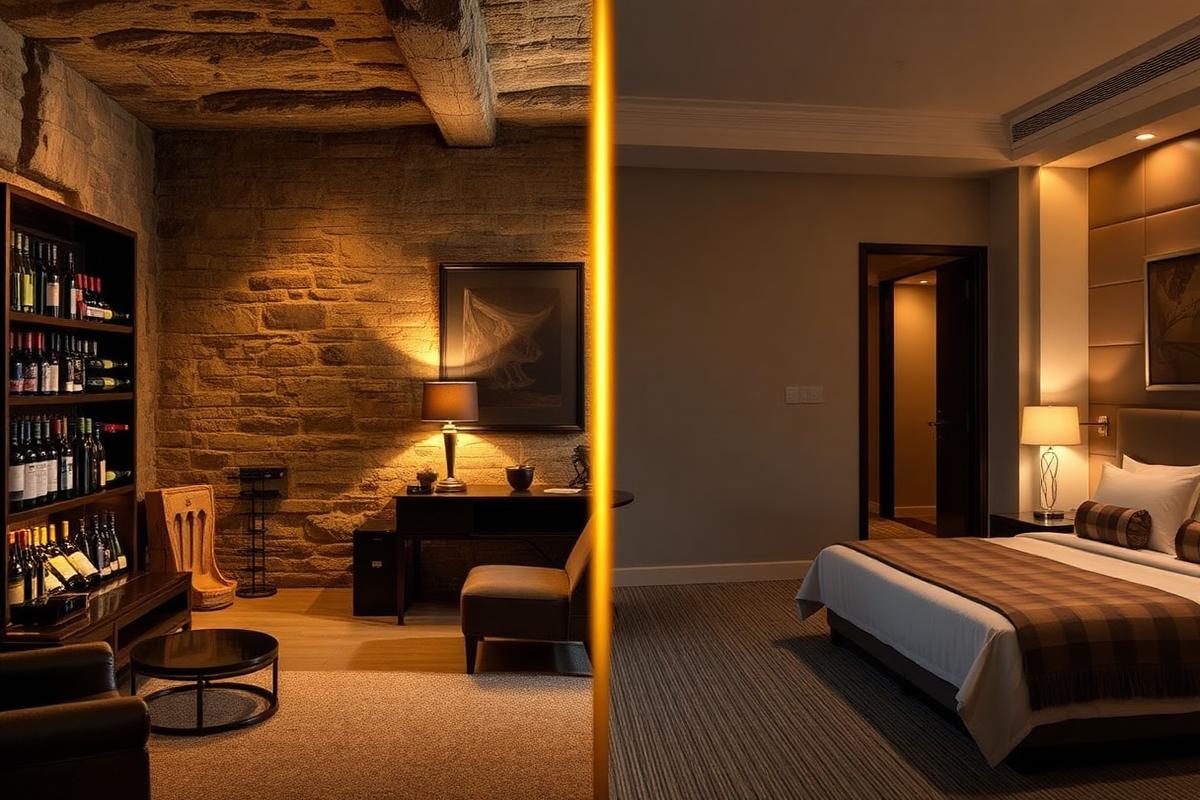
That is exactly the logic we followed in Dijon. At the Oenosuite, the only apartment in Bourgogne-Franche-Comté to carry the Vignobles & Découvertes label, the Jalunia connected cellar lets you taste Burgundy wines in tubes or bottles, self-service, from the suite itself: you work through several appellations without buying six bottles blind, and you leave knowing what you actually like before starting a relationship with an estate. The Route des Grands Crus is twenty minutes away, which leaves time to push the doors that do open. And to give that discovery to someone who already has, precisely, everything they need in their cellar, the Oenosuite gift card solves the date problem: any amount between 25 and 1,000 €, a personalised message, twelve months' validity, usable on any stay or experience. Book direct on oenosuite.fr or call 07 50 96 09 18.
Sources & references
Plan your trip to Burgundy
Book your wine accommodation in Dijon
Luxury wine suite with complimentary blackcurrant liqueur, Jalunia connected cellar and wine tourism experiences.
Book now